Are you using your health account discounts to the fullest extent?
Every dollar in an HSA or FSA goes in before taxes. For many people, that makes every health purchase about 30% cheaper than paying with a regular paycheck.
Most people spend that money on sick visits and cold medicine. But the better use is finding problems early, while they're still easy to fix.
This guide covers how each account works, how to use it at TrueScan, and what to do with your money in each month of the year.
HSA vs. FSA: what's the difference?
An FSA is use-it-or-lose-it. An HSA is use-it-when-it's-smart.
| Feature | HSA (Health Savings Account) | FSA (Flexible Spending Account) |
|---|---|---|
| Who gets one | People on an HSA-eligible, high-deductible health plan | Employees whose job offers one |
| Does the money expire? | Never. It rolls over every year. | Yes, at your plan's deadline |
| Rollover | Your full balance | Up to $680 into 2027, only if your plan allows it |
| 2026 limit | $4,400 self / $8,750 family | $3,400 per person |
| 2027 limit | $4,500 self / $9,000 family | Not yet announced |
| Age 55+ catch-up | Extra $1,000 per year | None |
| Can it grow? |  Yes, you can invest it |  No |
| If you change jobs | It goes with you | It usually stays behind |
New for 2026: bronze and catastrophic marketplace plans now count as HSA-eligible. If you buy your own insurance, you may qualify for an HSA for the first time.
Can you use an HSA or FSA for an MRI or heart scan?
Yes! The IRS counts body scans as a medical expense, even if you have no symptoms and no doctor's referral.
TrueScan accepts HSA and FSA cards. How you pay depends on the scan.
CCTA (AI heart scan): insurance first, HSA for the rest
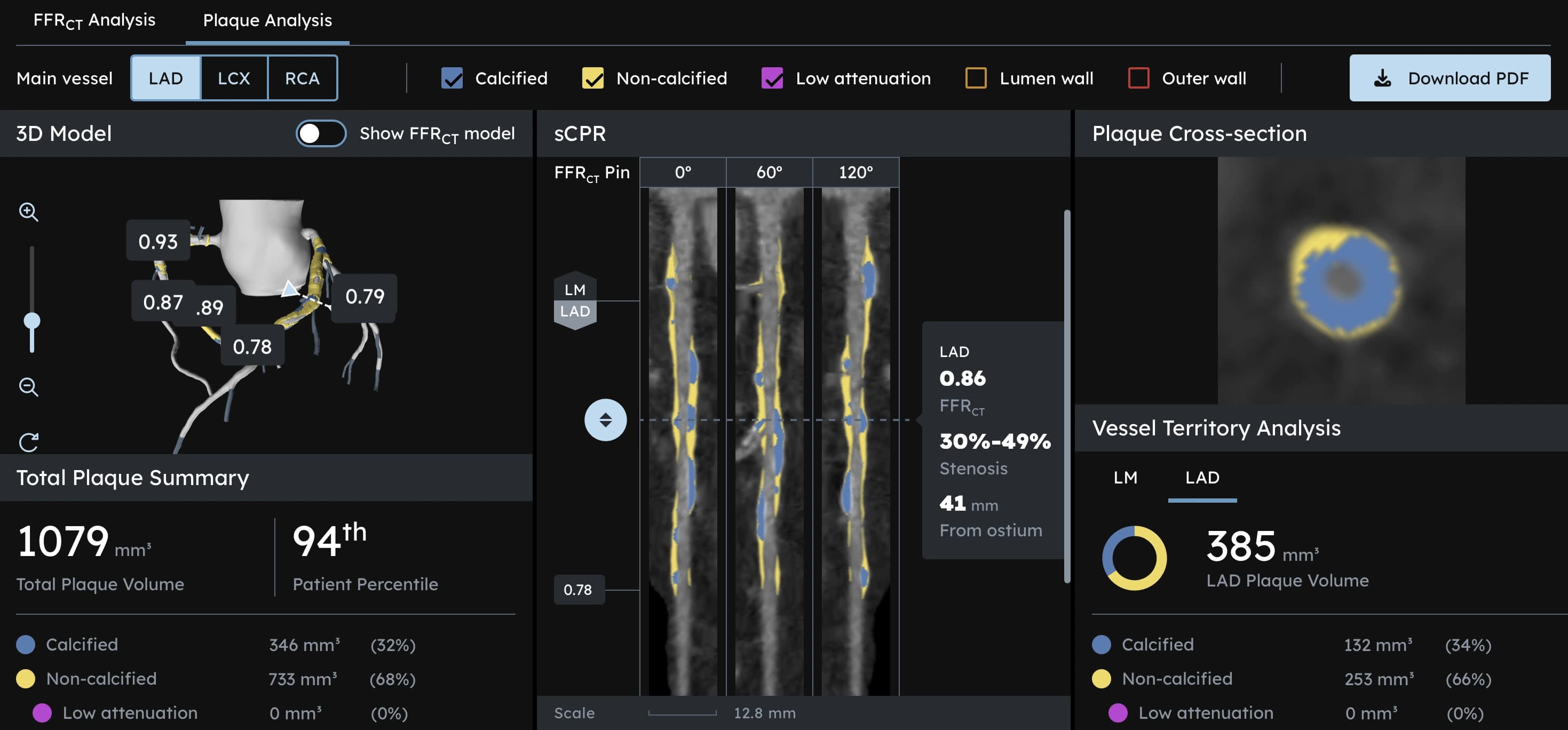
Our 15-minute Coronary CT Angiogram with HeartFlow AI is covered by insurance, including Medicare. Use your HSA or FSA for your deductible, copay, or coinsurance.
No coverage? The complete self-pay package is $1,295, and your HSA or FSA can pay for all of it.
Full-body MRI and diagnostic MRI, CT, and ultrasound: pay directly
These are direct-pay, with the price shown upfront. Swipe your HSA or FSA card at checkout, like a debit card.
Keep your receipt. Your plan administrator may ask for it, and your plan has the final say on what's covered.
For individuals looking for affordable financing, TrueScan monthly offers the option to pay all proactive scans over 12 months.
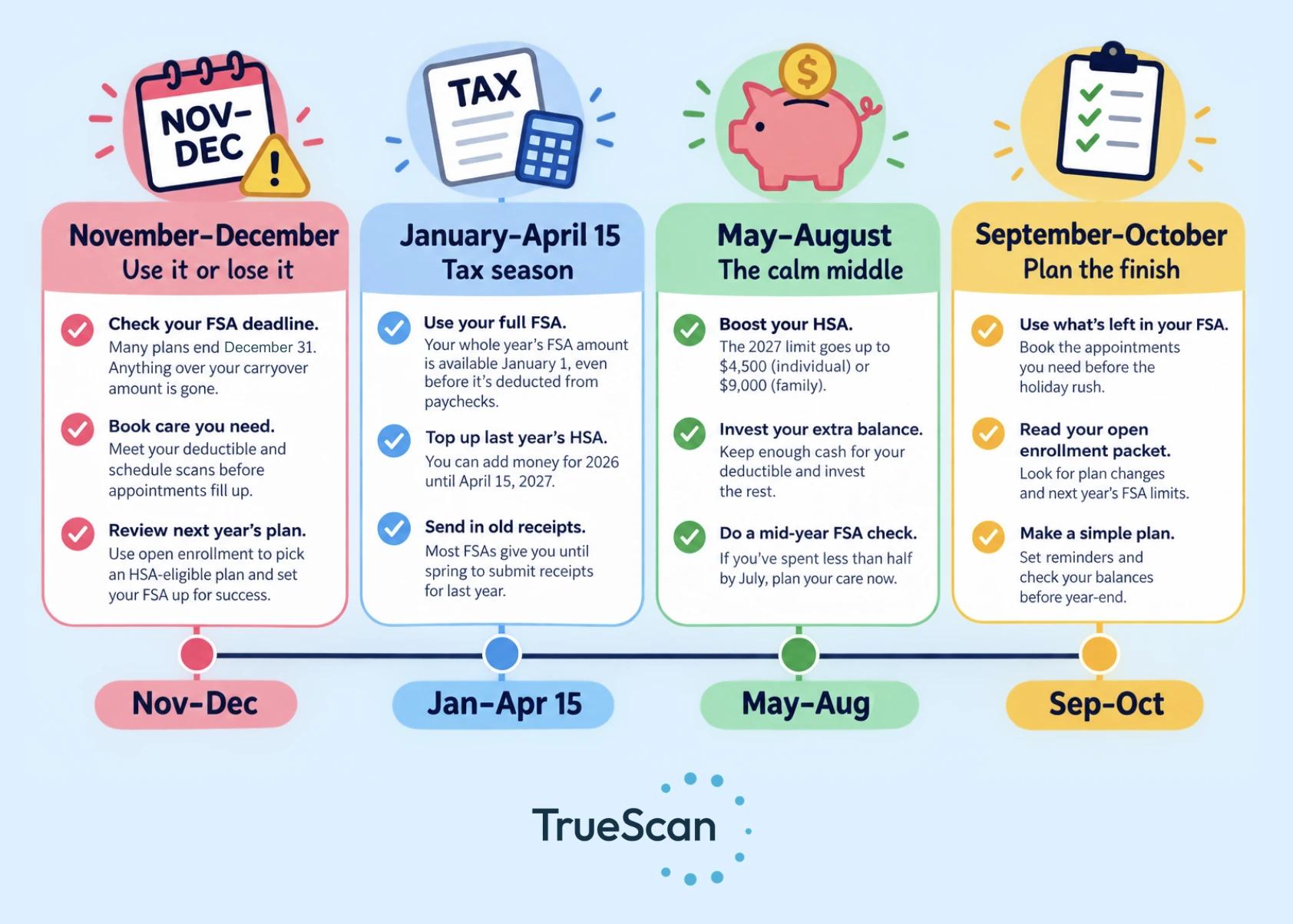
What to do with your HSA and FSA, month by month
The best move depends on the calendar. Here's what to do in each part of the year.
November–December: use it or lose it
This is the most expensive time to do nothing.
- Check your FSA deadline today. Many plans end December 31. Anything over your plan's carryover amount is gone.
- Met your deductible? Book now. Your insurance pays more for a covered scan like CCTA this year than it will on January 1, when your deductible resets.
- Book early. December appointments fill fast, and the date of your scan is what counts, not the date you booked.
- Don't panic-spend your HSA. That money never expires, so only spend it on care you actually want.
- Use open enrollment. Pick an HSA-eligible plan if it fits you, and set next year's FSA high enough to cover a planned scan.
January–April 15: tax season
This is when you can still fix last year and set up this one.
- Use your full FSA on day one. Your whole year's FSA amount is available January 1, even before it comes out of your paychecks.
- Top up last year's HSA. You can add money for 2026 until April 15, 2027. See the tax season playbook below.
- Spend last year's leftovers. If your FSA has a grace period, you usually have until March 15.
- Send in old receipts. Most FSAs give you until spring to submit receipts for last year.
May–August: the calm middle
This is when your HSA does its best work: growing.
- Raise your HSA contributions. The 2027 limit goes up to $4,500 for yourself or $9,000 for a family.
- Invest your extra HSA balance. Keep enough cash to cover your deductible and invest the rest.
- Do a halfway FSA check. If you've spent less than half by July, plan your care now.
September–October: plan the finish
This is when you set up a calm December.
- Count what's left in your FSA. Book the appointments you need before the holiday rush.
- Read your open enrollment packet. Plan changes for next year usually show up here.
Tax season playbook: how to get the most from your HSA
You can still add money to last year's HSA until Tax Day. Every dollar you add lowers last year's taxable income.
- Max out last year by April 15, 2027. The 2026 limits are $4,400 for yourself and $8,750 for a family, plus $1,000 if you're 55 or older. Tell your HSA provider the deposit is for 2026.
- Use the shoebox strategy. Pay for care out of pocket now and let your HSA grow. You can pay yourself back tax-free years later, as long as you keep the receipts.
- File Form 8889. It reports your HSA deposits and spending, and it goes in with your tax return.
- Don't count it twice. If your HSA or FSA paid for a scan, you can't also deduct it as a medical expense.
- Plan for 65. After 65, you can take HSA money out for anything, though non-medical spending is taxed like income. Once you join Medicare, you can't add new money.
Everyone's taxes are different. If you have more questions, a tax professional can tell you what fits your situation.
Frequently asked questions
Can I use my HSA for a full-body MRI? Yes. The IRS counts body scans as a qualified medical expense, even with no symptoms or referral.
Is a full-body MRI FSA-eligible? In most standard health FSAs, yes. A limited-purpose FSA, which covers only dental and vision, can't be used for it.
Does insurance cover a CCTA heart scan? At TrueScan, CCTA is covered by insurance, including Medicare. Your HSA or FSA can pay your share.
What happens to unused FSA money at the end of the year? Anything over your plan's carryover or grace period is lost. For 2026, the most a plan can carry over is $680.
Does unused HSA money expire? No. It rolls over forever and stays yours, even if you change jobs or retire.
What's the deadline to add money to my HSA for 2026? Tax Day: April 15, 2027. You can add money for the past year until then.
Can I use my HSA to pay for my spouse's scan? Yes, HSA money can pay for your spouse's and dependents' care. That's true even if they aren't on your health plan.
Should I spend my HSA now or save it? If you can afford to, paying out of pocket and saving receipts lets your HSA keep growing. If you can't, spending it on care you need is exactly what it's for.
Put this year's dollars toward next year's health
For more than half of people who have a heart attack, the first symptom is the heart attack itself. A scan paid with pre-tax dollars is one of the best deals in healthcare.
Book your CCTA, full-body MRI, or diagnostic scan at TrueScan before December 31. Bring your HSA or FSA card, and we'll handle the rest.
This article is for general information and isn't tax or medical advice. Check with your plan administrator and a tax professional.